

A Life in Wood and Music: Zigzag Luthier Ed Geesman Marks More Than 50 Years at His Craft

By Marie Kennedy, The Mountain Times
The workshop beside Ed Geesman and Lavonne Heacock’s Zigzag home holds the pieces of a life built around wood, music, and painstaking attention to detail.
On a sunny but cool afternoon, we sat beside their garden and sipped hot herbal tea before stepping into the workshop.
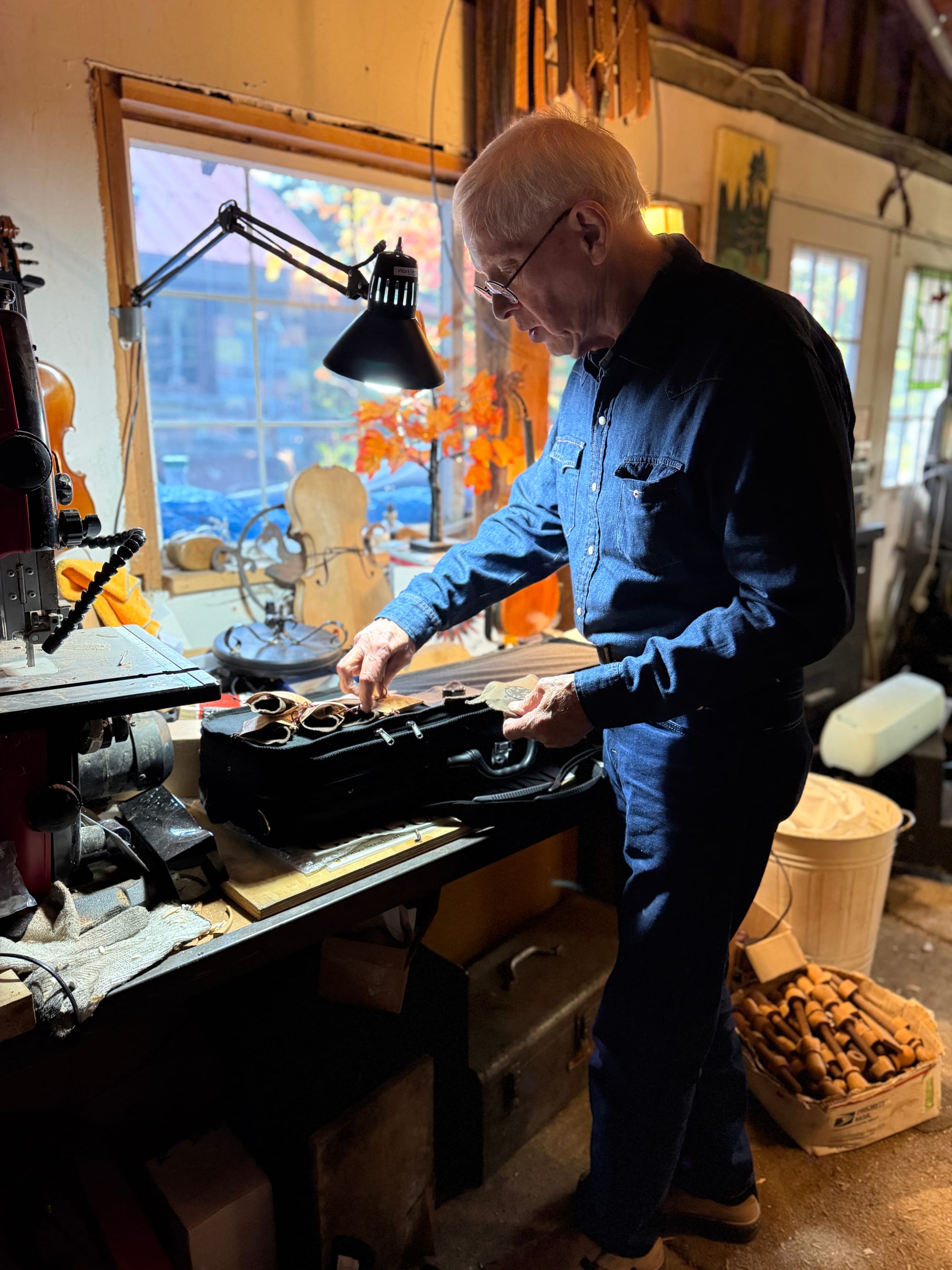
Inside, violins and violas made by Ed line the walls. Instruments awaiting repair rest on benches, cellos stand nearby, and seasoned wood and specialized tools fill shelves and corners.
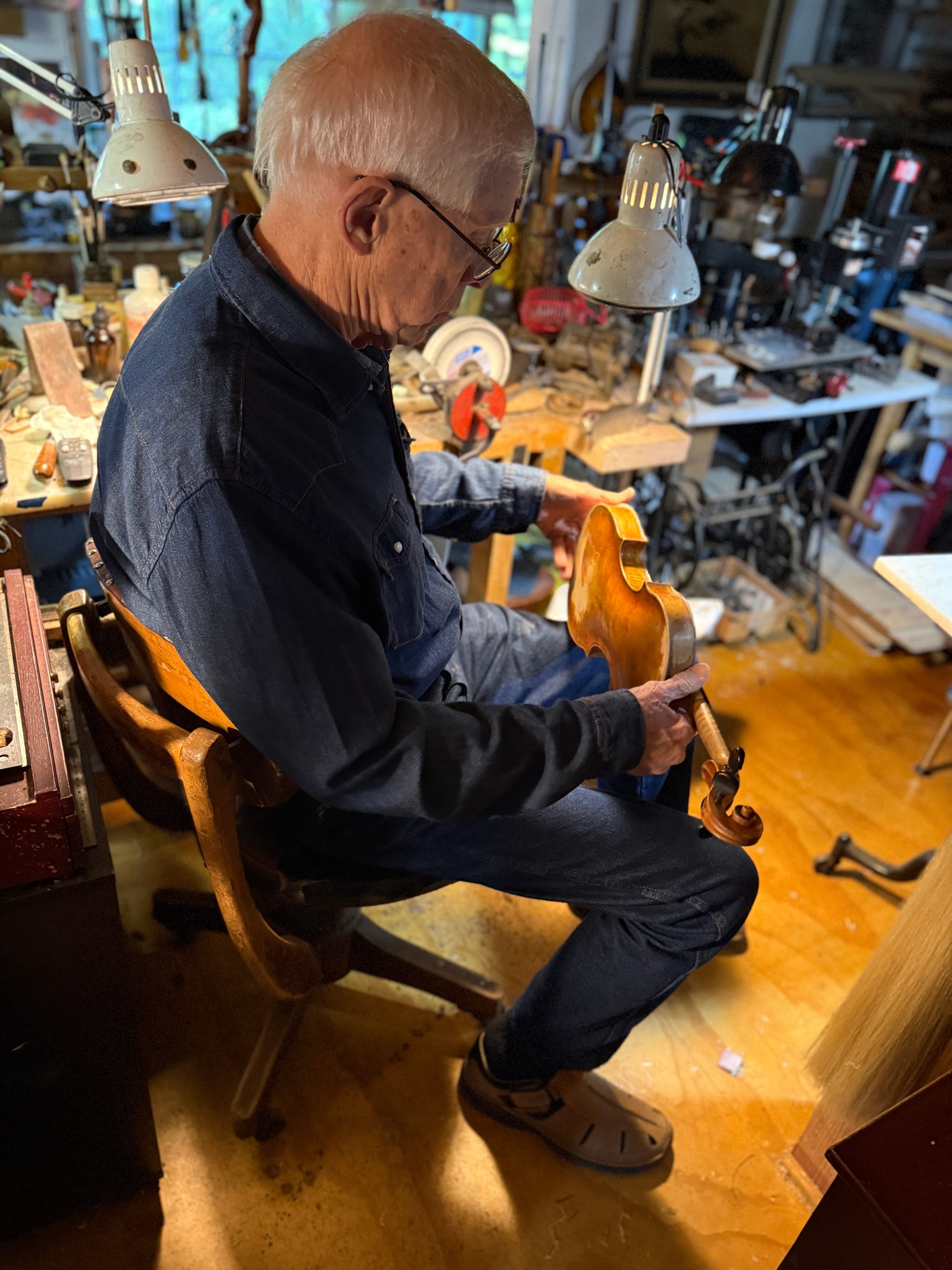
On Ed’s bench, the top has been removed from a violin, revealing the bass bar, soundpost patch and tiny wooden cleats that strengthen old cracks. He moves easily among the tools and instruments, explaining how each nearly invisible detail can change an instrument’s voice.
After more than 50 years as a luthier, or maker and restorer of stringed instruments, Ed finds the work second nature. But it has never become simple.
That precision seems reflected in Ed himself. He speaks quietly and in a measured way, with the same care he brings to his instruments.
Violin making requires a kind of sustained concentration that not everyone can tolerate.
“I’ve had apprentices over the years that have been at it for a year and just said, ‘I just can’t take it,’” he said.
Ed’s introduction to the craft came almost by accident. After serving in the Army, he worked as a waiter and bartender at the Old Spaghetti Factory in Portland. Interested in buying a violin, he visited a nearby shop operated by Paul Schuback.
Inside, he saw people making instruments.
“I thought, ‘So they still make violins?’” Ed recalled.
Schuback was looking for an apprentice and offered to teach him for $200 a month, a substantial amount in 1972. Ed accepted and apprenticed with him for three years before traveling to Mirecourt, France, to study with Schuback’s master, René Morizot.
He later went to Zurich, Switzerland, where a visit to another violin maker unexpectedly led to a job repairing instruments in a local shop.
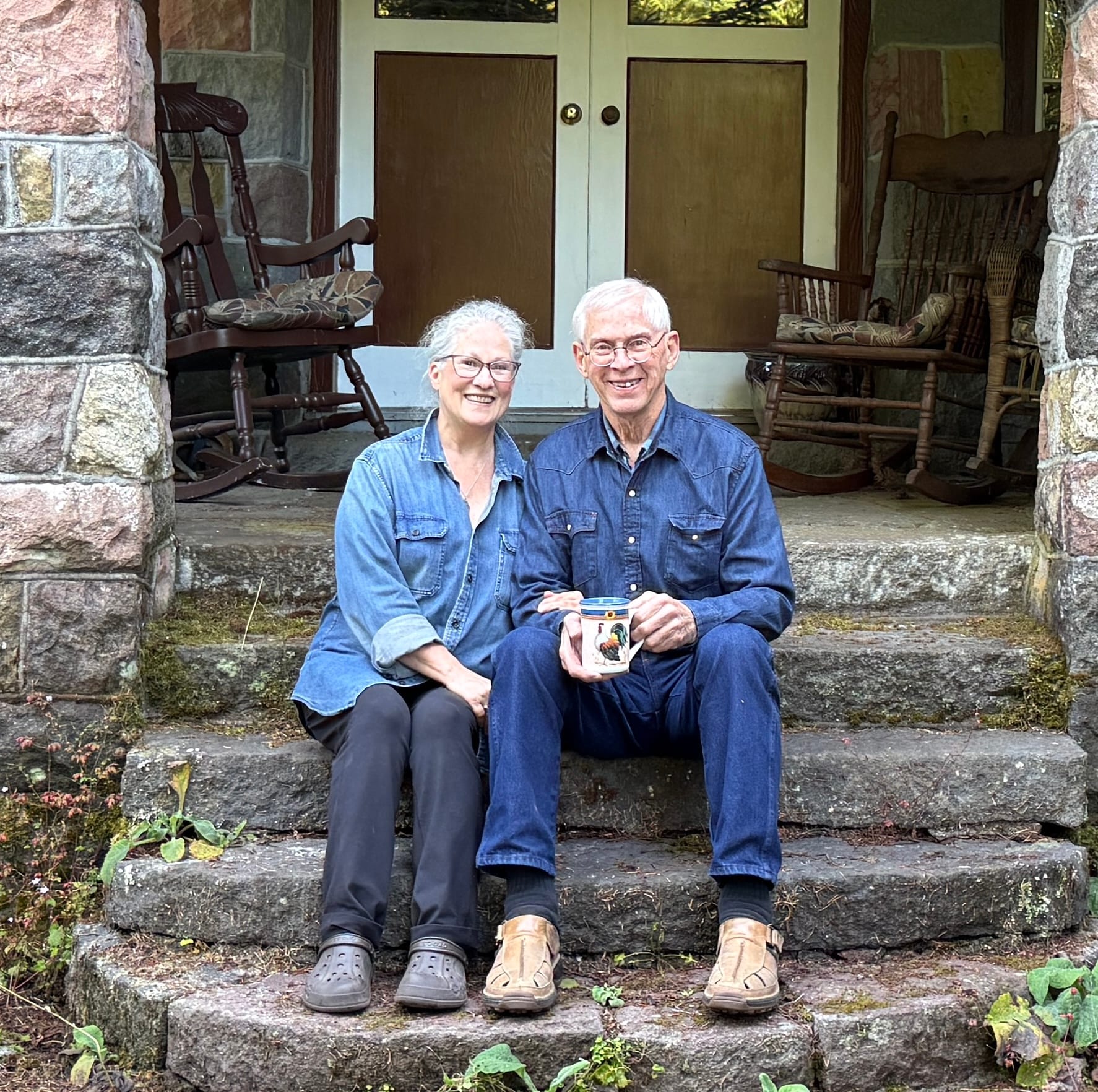
Ed eventually returned to the United States and opened his own business. Today, he operates Geesman Fine Violins in downtown Portland three days a week while continuing to build and restore instruments at home.
Because the commute can take as long as three and a half hours round trip, he is considering reducing his Portland schedule to two days, leaving more time for the instruments in his home workshop.
He has no plans to stop.
“I’m going to keep doing it as long as I can,” he said.
Lavonne has watched Ed’s knowledge and intuition deepen over their years together. She said his skill now goes beyond measurements and established techniques. When an instrument is placed in his hands, he seems able to read it.
“He’s reached a very special level as a maker,” she said. “He just has a wealth of knowledge.”
One of Ed’s most significant recent projects was creating a copy of a Guadagnini violin played by Yumi Hwang-Williams, concertmaster of the Colorado Symphony.
Hwang-Williams was reluctant to travel with the instrument, which Ed said is worth about $2 million. She and a companion brought it to his Portland shop so he could photograph it and measure the thickness of its carved top and back.
The Guadagnini arrived at his shop in November. Hwang-Williams picked up Ed’s completed copy in July.
Lavonne remembered the day Hwang-Williams returned to compare the two violins. Violinist Adam LaMotte, who shares the Portland shop with Ed, joined her in playing both instruments side by side.
“It was such a beautiful, rich celebration of all of this work,” Lavonne said.
For her, the moment represented not only the completion of an important instrument but the culmination of decades of Ed’s work.
“It was like the dessert of your life,” she told him.
Making new instruments is only part of Ed’s craft. Restoring an old or badly damaged instrument presents a different kind of puzzle.
He once rebuilt a violin belonging to the San Diego Symphony’s concertmaster after it had been “smashed to smithereens.” The musician received an insurance settlement and gave Ed what remained of the instrument.
Ed collected the broken pieces, glued them together and created a plaster cast to support the violin during its reconstruction. Once restored, the instrument was sold.
He uses traditional hide glue, which is water-soluble and allows a future craftsperson to reverse the repair without causing further damage. Cracks near the soundpost or bass bar may also require an inlaid reinforcing patch.
Even the placement of the soundpost can change an instrument’s tone. Makers begin with precise measurements but adjust the post as they listen for the best sound.
Ed is also passing along what he has learned. He assists LaMotte at the Portland shop and is teaching a young apprentice named Charles to rehair bows and carve bridges. While working for Schuback, Ed spent summers rehairing bows brought in by schools from across Oregon.
At home, he has found another way to connect his profession to the place he and Lavonne love.
Ed makes Mountain Rosin from pitch gathered from dead and fallen trees in the surrounding forest. Rosin is rubbed on bow hair to create the friction needed to draw sound from a violin, viola, cello, or bass string.
The raw pitch contains bark and other debris. Ed heats it until the resin begins to flow, then filters it at least four times before pouring it into small silicone bakery molds.
The finished cakes are smooth and amber-colored, with a woodland scent Lavonne particularly loves. They also have enough grip to appeal to professional musicians.
A Carnegie Hall manager who recently rented one of Ed’s cellos while visiting Oregon bought three cakes for $20 each. A New York violin shop has also expressed interest in carrying the rosin, although expanding production may be difficult given the labor involved.
His life on the mountain began in January 1987, after a recession devastated his business in San Diego. Even the San Diego Symphony went bankrupt during that period, he said. As work disappeared, Ed lost his car and home.
At the same time, his father was diagnosed with lung cancer. Ed returned to the Northwest with his two young children to help his mother care for his father.
He also wanted a safe place to raise his family. Having spent part of his youth near Mount Rainier, he was drawn to the mountains and came directly to the Mount Hood area.
He soon became part of the community, coaching T-ball and basketball and serving as president of the local baseball organization.
During his first Christmas in the area, his new neighbors showed him what kind of community he had found. After Ed took his children to Bi-Mart in Gresham to purchase gifts, someone stole his car with all the presents in the trunk.
Friends offered him a vehicle to drive. Then community members arrived with what he described as “a big, huge bag full of Christmas presents.”
“It was wonderful,” he said.
Ed met Lavonne through their young daughters, who were playmates at a day care near Welches School. The two also attended Hoodland Lutheran Church. They married in 1989 and raised their blended family in the area.
Their lives became intertwined with the mountain, their children, the community and the instruments that continued to pass through Ed’s hands.
The couple briefly moved to Portland but returned to their Zigzag home. Before they had unpacked everything, they carried a mattress upstairs and lay down.
After the constant drone of traffic, trains, and city activity, Lavonne was struck by what she heard outside the window.
Nothing.
“Here it was just so quiet,” she said.
The stairs in their multistory home could become more difficult as they grow older, but leaving would mean giving up more than a house. Their workshop, studies, library, and garden are all there.
For now, they plan to remain in the home where they raised their family and built their life together.
“We have grown old right here together,” Lavonne said. “And that’s the plan.”