
What the Forest Knows About Getting Along
By Dr. David Wenzel, For the Mountain Times
It isn't difficult these days to find evidence that we are divided. Turn on the television, scroll through social media, or spend too much time reading the comments beneath almost any news story and you might conclude that we have forgotten how to live with people who see the world differently than we do.
Politics, religion, culture, even where we choose to get our news, can divide us into camps. Increasingly, we don't simply disagree with one another. We become suspicious of one another.
Then I walk into the forest.
A forest is about as diverse a community as you can imagine. In our small woodland forest, Douglas firs tower above western red cedars, maples, alders, hemlocks, vine maples, sword ferns, mosses, fungi, and countless plants I still can't identify. They aren't all doing the same thing.
Some need sunlight. Others flourish in shade. Some grow quickly and live relatively short lives. Others grow slowly and may remain for centuries. Some send roots deep into the soil, while others spread them closer to the surface.
And yes, they compete.
Trees compete for sunlight, water, nutrients, and space. Nature isn't the peaceful Disney movie we sometimes imagine it to be. But competition is only part of the story.
A healthy forest also depends upon relationships.
Fungi form vast underground networks around tree roots, helping plants gain access to water and nutrients while receiving sugars in return. Fallen trees slowly decay and become nurse logs, providing moisture and nutrients for the next generation. Dead trees become homes for birds, insects, and small animals. The canopy moderates temperatures below, while roots help hold soil in place and slow the movement of water.
The forest works because its members are different yet deeply dependent upon one another.
I wonder whether there is something in that for us.
We often seem to approach disagreement as though someone must win and someone must lose. If your ideas prevail, mine must have been defeated. If you belong to that group, perhaps you cannot belong with me.
But communities, like forests, need diversity.
We need people who see problems differently. We need the cautious person asking what might go wrong and the adventurous person asking what might be possible. We need people who preserve traditions and people who challenge them. We need the young, who sometimes wonder why things can't change tomorrow, and the old, who remember why some things came to be in the first place.
A healthy community doesn't require everyone to think alike.It requires us to remember that we need one another.
For more than 30 years, I've called this mountain community home. Like any community, we have our disagreements. But I've also watched people show up when a neighbor's house burns, a tree falls across a road, someone becomes ill, or a family needs help. In those moments, we seem to remember something that is easy to forget during an election year: the person on the other side of an issue is still our neighbor.
Perhaps the forest offers us an important distinction: Unity is not the same thing as uniformity. A forest made entirely of identical trees would not necessarily be a healthy forest. Resilience comes, in part, from variety - different species, different ages, different roles, all occupying the same ground.
Maybe our communities aren't so different.
We don't have to agree about everything. We probably shouldn't. But perhaps we could become a little more curious about the people growing beside us. We might even discover that someone whose branches seem to reach in a very different direction still shares much of the same soil.
The forest has been practicing that kind of community for a very long time. We might have something to learn from it.
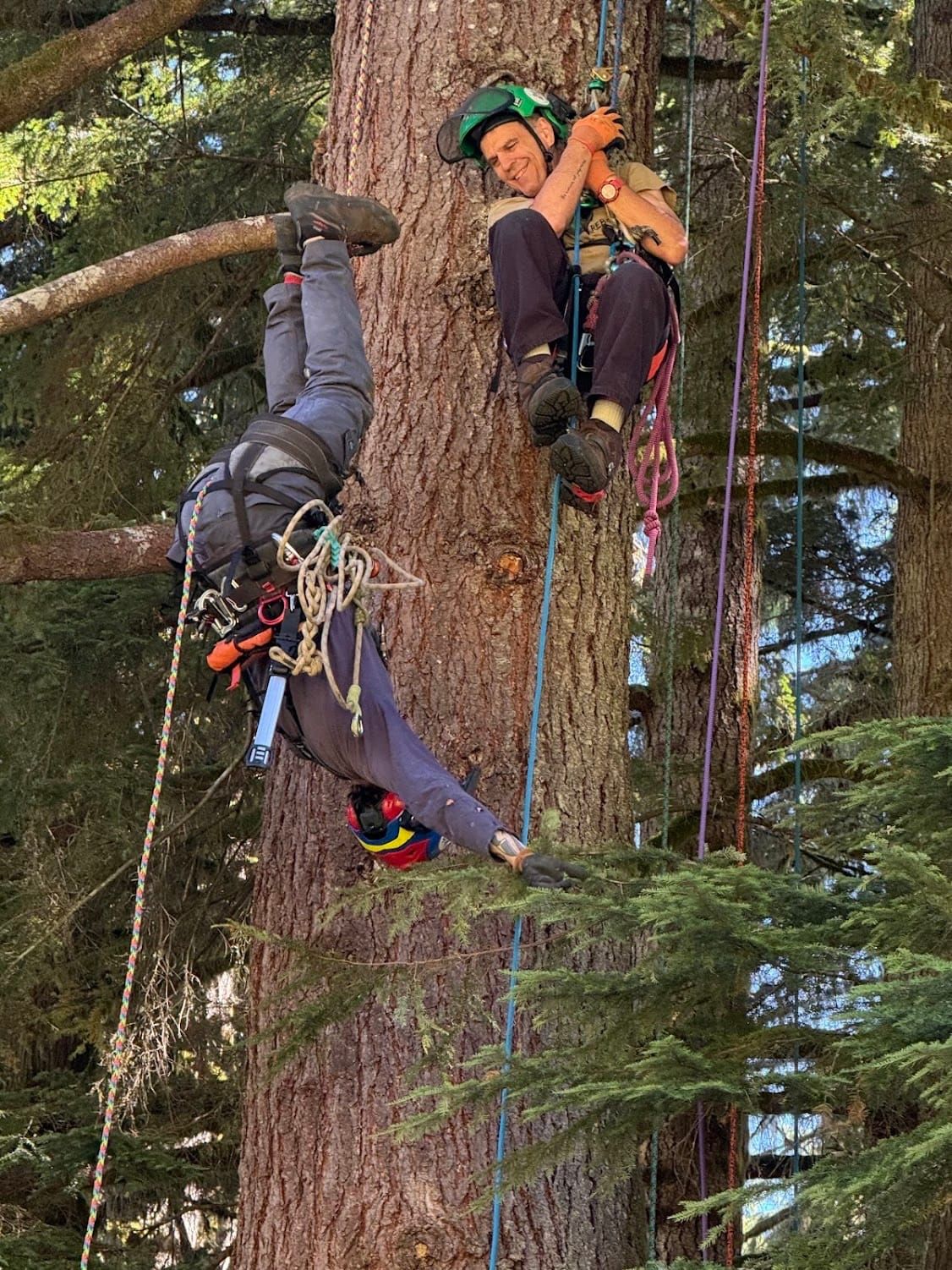
Dave Wenzel has lived in the Mt. Hood community for more than 30 years. He and his wife, Hollis, care for a 20-acre woodland they affectionately call the “20 Acre Wood.” Much of his time is spent managing the forest, planting trees - including as many redwoods as he can before he himself, like the trees, falls to the forest floot - welcoming guests to their Treehouse, and reflecting on what nature can teach us about life, community, and meaning.