

What’s Beneath Our Feet
By Dave Wenzel, for The Mountain Times
The next time you're walking through Government Camp, exploring a trail near Zigzag, or enjoying the forests around Welches, I'd like you to consider what's beneath your feet. Much of the landscape we call home was shaped by Mt. Hood's volcanic past. Some of the ground beneath our mountain communities consists of ancient volcanic mudflows, known as lahars, that carried enormous quantities of rock, mud, and debris down the mountain's slopes and into its river valleys.
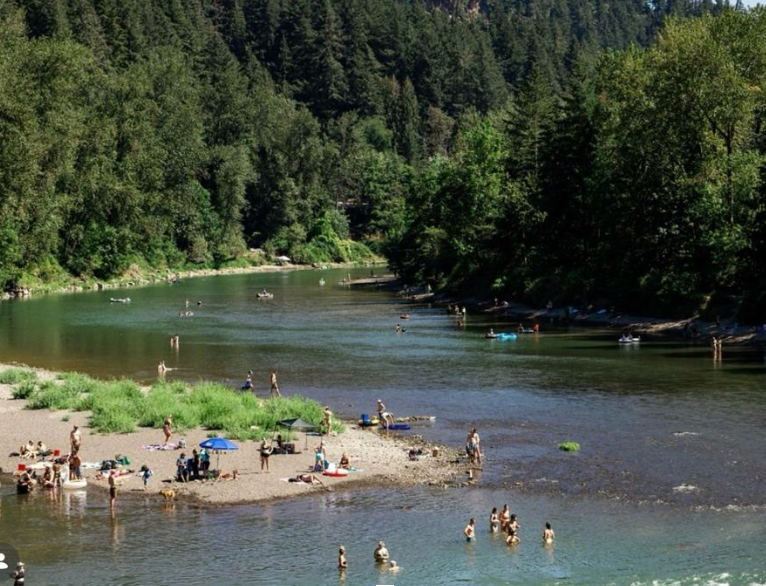
Here's a fascinating bit of local history. When Lewis and Clark reached the mouth of the Sandy River in November 1805, they encountered a river dramatically different from the one we know today. It was wide, shallow, and so choked with sand and sediment that they called it the "Quicksand River." What they didn't know was that roughly two decades earlier, during the era of the American Revolution, Mt. Hood had experienced a significant eruption, sending enormous quantities of volcanic debris into the Sandy River watershed. The river was still carrying that material downstream when the explorers arrived. Imagine that! The mountain we admire today had been actively reshaping our landscape within a generation of Lewis and Clark's visit. And the evidence was literally flowing past their boats.
I tend to think of Mt. Hood as a beautiful, relatively permanent backdrop to our lives. But the mountain is neither permanent nor finished. It is still changing, building itself up and wearing itself down, operating on a timeline almost impossible for us to comprehend. The ground beneath our feet holds layer upon layer of evidence that the mountain is not a fixed object but an ongoing process.
And, of course, so are we.
Most of us live as though our lives are relatively stable. We get up, go to work, care for our families, and follow familiar routines. One day looks remarkably like the next. The changes are so gradual that we hardly notice them. Children grow, relationships evolve, our bodies age, and our understanding of the world shifts, often without realizing just how much we've changed.
Then something happens that makes the passage of time impossible to ignore.
Last year, we lost my stepfather, my mother's husband of 43 years and the last living grandfather to our children. His death marked the end of a chapter in our family's story. Suddenly, the passing of time wasn't something abstract. It was painfully real. Someone who had been part of the familiar landscape of our lives was no longer there.
Experiences like that remind us that change isn't always gradual or gentle. Sometimes it arrives with the force of an eruption, rearranging the landscape of our lives almost overnight. Other times it happens so slowly that we don't recognize it until we look back and realize how different things have become.
And change isn't always loss. Sometimes it is growth, discovery, or the unexpected beginning of something wonderful. Like the mountain, we are continually being shaped by forces both within and beyond our control. We are never quite the same people we were yesterday.
Perhaps that's one of the gifts of living in a mountain community. We spend so much of our lives gazing up at Mt. Hood, looking at a mountain that, except for the weather, seems largely unchanging. Yet beneath that familiar silhouette is a history of extraordinary transformation, and a future that will undoubtedly hold more.
I'm beginning to understand that the mountain is no more finished than I am. We're both being shaped by forces beyond our control, both changing in ways that aren't always visible, and both part of stories much larger than ourselves.
The mountain simply has a little more time to figure things out.
Dave Wenzel has lived in the Mt. Hood community for more than 30 years, where he and his wife, Hollis, care for small woodland they affectionately call the "20 Acre Wood." His days are spent managing the forest, planting trees (including as many redwoods as he can before he dies), welcoming guests to their Treehouse, and appreciating the lessons that nature has to teach about life, community, and meaning. Thoughts and questions can be sent to davewenzel14@gmail.com